| Home | | | Bio | | | Gallery | | | Art Instruction Field Notes | | | Suggested Materials | | | ZOOM Events | | | Guestbook | | | Mailing List | | | Links | | | Contact |
Field Notes: Notes on Tones
"Gray is not the negation of color, but the presence of it." ~ WILLIAM MORRIS HUNT, On Painting & Drawing
Notes on Tones
Learning to see should be the goal for which all painters strive, whether they are just beginning or have painted for many years. The guiding principles for this study include the natural vision; tone and color; light and shade; form, atmosphere, and focus. Most important for the outdoor painter is the study of values.
The study of light and shade – in order to paint an impression of the visual world – began in the 15th-century with Leonardo da Vinci (1452-1519) and his theories have provided the scientific foundation for understanding natural vision ever since. Before Leonardo, an outline ‘sensed’ by the painter was the most important means of rendering forms in nature. But the impression of light on form – which in turn creates half tones and shadows – is a far more perceptive way to understand seeing. When outlines become more important than seeing the big impression of light and shade, the natural look is lost.
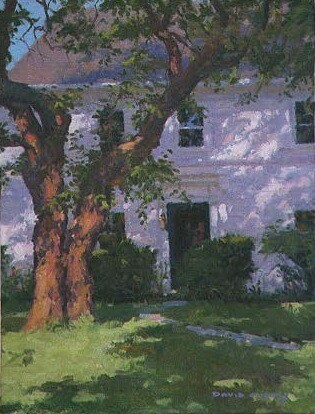 Impressionist Seeing – Here, of course, ‘impressionist’ refers to the natural vision of the painter and his or her understanding of large tonal masses, as opposed to ‘Impressionists,’ which denotes the popular French artistic movement of the 19th-century.
Impressionist painting outdoors is a matter of painting the correct color value and juxtaposing it beside the next correct color value. The process is continued until the painting is finished. This simple approach is difficult to understand and even harder to put into practice. For study purposes, the separation of a color from a value may be of greater importance. Color is psychological and personal by its very nature, but the tone – and observing this in nature – creates a greater foundation for a composition in painting.
The imagined scale from black to white are values. Each tone found in nature is related to that scale. The lightness or darkness in a tone – within a group of tones – should be harmonious. This is the KEY of the painting.
Because of the brilliance of the outdoor world, matching color values on a canvas is practically impossible. Most tones are both higher in value and stronger in hue than colors we spread on our palette. Keying the outdoor sketch, according to the scale of values relative to the perception of nature, was the great discovery of 19th-century art, and constitutes a painting technique still used in painting the plein air landscape today.
"Half shut your eyes. Look at the whole thing. get the local color, or value, of this and that, and there." ~ WILLIAM MORRIS HUNT, On Painting & Drawing
The impressionist approach to landscape is what made the French ‘Impressionists’ the leading luminaries of painting out of doors. The main credo of these artists was to paint direct from nature, under open skies, and not in the studio. They discovered  that the darkest tones in nature were far more luminous and filled with color than the dark tones of a studio landscape, which often appeared too black. An artist who refers to nature in order to key the dark tones of the painting, and then proceeds up the value scale to the lightest tones, will find the key of the painting is raised within the darks. The brightest colors in nature cannot be reproduced in paint. However, the maximum lightness of value and color – within the harmony of the darks and middle tones – can create a quality of atmosphere and outdoor light. This technique of seeing out of doors, coupled with the brilliance of natural sunlight, tends to soften the forms, but even so, composition, design and rendering the shapes accurately should not be sacrificed; otherwise the inspiration of the landscape is lost. Local color and the forms of nature, which constitute the most obvious perceptions made by the painter, can often lead to weak looking landscapes. Once a painter begins the study of tonal relationships of value – from light to dark on the invisible scale – the aesthetic quality found in these relationships, with reference to nature, becomes the inspiration to create a more perceptive landscape.
"When you learn what values are, you'll find that a picture exists." ~ WILLIAM MORRIS HUNT, On Painting & Drawing
To begin your landscape, orient yourself to the four directions, noting especially where the sun is and where it is going! For a landscape artist, there are two distinct lighting effects. Front light means looking at a scene where the sun effect is on your subject. This effect is seen when facing in a northerly direction. Backlight is the other distinguishing light effect found in nature, and this occurs 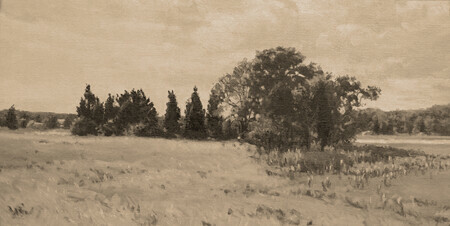 when the artist is looking directly into the sun with the light behind the subject. Modifications of these two effects, such as looking east-south-east in the height of summer, produces backlight while looking north-north-east under similar conditions is front light.
The time of day you choose to paint, and the lighting effect created by that hour, is in essence, the main principle of good landscape painting. You must perceive and orient yourself to the changing light, and anticipate or remember your scene the way it looks under one light. The half hour – that is, a thirty-minute period – is the best goal to aim for. It may take a painter a whole day to achieve full orientation of the subject under one light, and on the second day – with the knowledge of where the sun will be at the half-hour you choose for the lighting effect on your composition, the painting can be progressed accordingly.
A canvas should not be exposed to direct sunlight. The sun moves and changes its angles, and this in turn will affect your values. 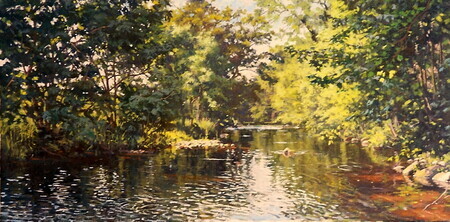 Umbrellas to shade canvas and palette are popular among many outdoor painters, or you could try pointing your easel towards the sun to create a shadow on the canvas. This will help you to paint in the proper key, in order to get the true effect of nature.
To begin, find the color in nature that comes closest to the white on your palette, and then find the note that comes closest to the dark. These comparisons of light and dark are the most important observations you can make. While painting, always compare. Remember the nature of sunlight, and its subsequent brilliance, is not paintable. Understanding a relative value key for your painting is the correct way to proceed.
"It is so hard and long before a student comes to a realization that these [first] few large simple spots in right relations are the most important things in the study of painting. They are the fundamentals of all painting." ~ CHARLES HAWTHORNE